Civil nuclear projects in the country would be subject to Indian laws including on issues of civil liability, National Security Adviser Shivshankar Menon said on Friday dismissing reports of attempts to dilute the liability clause in contracts proposed with United States firms.

He said there is a need to pave the way for India to benefit from nuclear power without restrictions.

With the regulatory approval from the US Department of Energy in its kitty, Indian multinational conglomerate L&T is planning to focus on manufacturing small modular reactors (SMRs) to play a leading role in the commercialisation of nuclear energy in India.
M R Srinivasan focused on the peaceful use of nuclear power at a time when the popular view among the 'hawks' was that India should build a nuclear arsenal as a deterrent.

The United States and India are on the verge of finalising a landmark bilateral trade deal, aiming to boost trade to USD 500 billion by 2030, according to US Deputy Assistant Secretary of State Bethany Poulos Morrison. The agreement seeks to open India's 1.4 billion-strong market to American goods on reciprocal terms, with ongoing high-level discussions to recalibrate the pact after recent changes in US tariff policy.

Leaders of the two countries, however, did discuss on Pakistan's nuclear safety and security which is an ongoing discussion.

External Affairs Minister S Jaishankar and US Secretary of State Marco Rubio discussed cooperation in trade, critical minerals, nuclear energy, and defence, reaffirming commitment to a free and open Indo-Pacific.

A pact between the NPCIL and Westinghouse to build six power reactors in Andhra Pradesh is unlikely to be signed.

'There has definitely been a breakthrough in the nuclear logjam. It is good to see nuclear energy back on the rails,' says Dr Anil Kakodkar, former chairman, Atomic Energy Commission.

Prime Minister Narendra Modi and Sri Lankan President Maithripala Sirisena on Monday held talks at Hyderabad House

In a bid to de-escalate Middle East tensions, the US has presented Iran with a comprehensive 15-point peace plan focusing on nuclear disarmament and regional stability in exchange for sanctions relief.
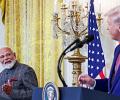
Prime Minister Narendra Modi and US President Donald Trump have vowed to move forward with plans to work together to build US-designed nuclear reactors in India. The decision was made during their meeting at the White House, where they also agreed to significantly expand energy cooperation. The move comes after India announced plans to amend its nuclear liability law and the Atomic Energy Act, which had previously been obstacles to the implementation of the US-India civil nuclear deal.
Reflecting their desire to deepen the strategic partnership, India and Germany have for the first time discussed the possibilities of entering into bilateral cooperation in civil nuclear energy.
The India-US nuclear deal was aimed at ending India's nuclear isolation and nuclear apartheid, recalls Rup Narayan Das.

The Summit would begin on the second day with the prime minister interacting with Russian and Indian CEOs.

For India, much is at stake: Crucial energy supplies traversing the Strait of Hormuz, the fate of its 10 million citizens living and working in West Asia -- who send generous remittances home -- and its major trade links with the region.
The two countries held annual foreign office consultations.
Gopal Krishna makes a case against the nuclear liability bill.

The winter session of Parliament is set to begin with the government prioritizing its reforms agenda, including a bill to open the civil nuclear sector to private players. The opposition is expected to raise concerns about electoral roll revisions and air pollution.

India on Tuesday said cooperation in peaceful uses of nuclear technology is an important pillar of the multifaceted cooperation with Russia, which offered help in building small tropical nuclear power stations.

Prime Minister Manmohan Singh and his counterpart Stephen Harper hailed the signature of the nuclear agreement after their one-on-one and delegation level talks that will provide for cooperation in civil nuclear energy, including import of uranium and equipment from Canada.
On the eve of his visit to Tokyo, Prime Minister Manmohan Singh has said that he hopes to strengthen strategic and global partnership with Japan and reach an early agreement with regard to civil nuclear energy cooperation.
"In our dialogue with the Pakistani government, we have clearly said we will work with them on civil nuclear energy," Clinton told a group of Pakistani journalists in Islamabad on July 19, according to the transcripts made available by the State Department.

US Vice President JD Vance is set to arrive in Islamabad on Monday evening to lead a high-level American delegation in a second round of ceasefire negotiations with Iran, CNN reported, citing White House on Sunday.

Ahead of the expiry on Tuesday of the two-week ceasefire declared by US President Donald Trump in the conflict with Iran, US media outlets reported on Sunday that negotiators Steve Witkoff, special envoy for peace missions and Jared Kushner will head to Islamabad for talks with Iran.

The agreement will form the basis of wide-ranging bilateral cooperation from basic and applied research to full civil nuclear cooperation, including reactors, nuclear fuel supply, nuclear safety, radiation and environment protection and nuclear fuel cycle management, officials said. The nuclear agreement and the social security pacts were signed after the Summit meeting between Prime Minister Manmohan Singh and French President Nicholas Sarkozy at the Elysee Palace in Paris.

India and the US signed a historic agreement to cooperate in civil nuclear energy sector in October 2008.
"The enemies of the country want to project the militancy in the country as indigenous and for this purpose, they have been recruiting some local youth for arms training," he said.
India and Russia today signed an agreement on civil nuclear cooperation with Prime Minister Manmohan Singh describing it as a "new milestone" in bilateral relations.
'We note the commitments India has made... We look forward to reinforcing our partnership with India,' said the document issued by the US, Russia, France, UK, Italy, Germany, Canada and Japan.

On the table are additional batches of S-400 surface-to-air missile systems from Russia, which India used with immense success during Operation Sindoor. India could buy at least two squadrons of Su-57 fighter jets plus joint production of S-500 air defence systems.
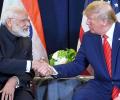
It would be the prime minister's first bilateral visit to the US after Trump became president for a second term.

Through his commitment to democratic norms, debate, dissent and constitutionalism, Jawaharlal Nehru helped ensure that parliamentary democracy took deep root in independent India. Utkarsh Mishra evaluates Nehru's 17 years as India's first prime minister, examining his role in nation-building, democratic institution-building, economic planning, scientific advancement and foreign policy.

US President Donald Trump on Sunday expressed confidence that Tehran would eventually concede to American demands, while simultaneously issuing a stern warning regarding the potential for total military devastation.

During the talks with Prime Minister Narendra Modi, French President Francois Hollande reassured reliable, uninterrupted and continued access to nuclear fuel supply throughout the entire lifetime of the plants while acknowledging India's need for the same.
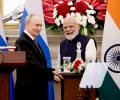
India and Russia have solidified a five-year plan to enhance their economic and trade partnership, while also addressing the ongoing conflict in Ukraine and the threat of terrorism.
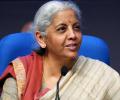
'If the BJP detoxifies the nuclear liability law, it will bring economic, environmental and, most of all, strategic benefits.' 'Let's keep our fingers crossed and hope that this Budget promise is met soon -- ideally, before Mr Modi heads to his first meeting with Trump 2.0,' observes Shekhar Gupta.

The question is no longer whether the war will expand. It has. The next few days will tell us whether the war stabilises around Hormuz or whether the Strait itself becomes the trigger for a far larger rupture. What to watch for over the next 48 hours is simple: Any move by the US toward direct naval control of the Strait; any credible Iranian attempt to disrupt or mine shipping lanes and, critically, whether energy infrastructure in the Gulf continues to be targeted.If those lines are crossed in tandem, the war will no longer be containable within the region.
